Millions of wild animals continue to die slow, painful, and inhumane deaths as part of official wildlife “management” schemes, according to research recently published by the Environmental Claims Journal.
It’s not novel news that U.S. wildlife regulatory agencies — such as the Environmental Protection Agency (EPA), the U.S. Fish and Wildlife Services (USFWS) and the USDA’s APHIS Wildlife Services (WS) — use lethal methods to “manage” wildlife populations.
But what’s less-known is just how cruel — and how widely used — those methods are, according to the study by researcher Sahana Ramdas.
More than eight million wild animals lost their lives over a three-year stretch between 2015 and 2017 in WS “management” alone, Ramdas said, during a presentation hosted virtually by Animal Legal Defense Fund.
In 2016 alone, Wildlife Services killed at least 2.7 million animals — including more than 21,000 beavers, close to 1,000 bobcats, more than a combined 800 grey wolves and black bears, and more than 330 mountain lions. An additional 2,790 wild animals were “unintentionally” killed during WS operations, Ramdas said.
Ramdas said a large part of the problem is that regulatory agencies continue to buy into outdated and data-disproved myths, including that hunting helps reduce conflicts between humans and wild animals or that lethal methods are “humane.”
“At best, their objectives are misaligned in nature, as their ‘wildlife management’ work involves killing millions of wild animals on a yearly basis, despite mounting evidence that it’s ineffective and continues to use all forms of inhumane leg traps, lethal poisons, and weapons,” she said.
USDA APHIS spokesperson Gail Keirn said she was not familiar with Ramdas’ study but confirmed the agency sees lethal methods of removing wildlife as a viable management tool.
“We understand that some people do not agree with the use of lethal methods to manage wildlife or reduce wildlife damage,” she told Lady Freethinker. “(But) the use of lethal methods to remove wildlife is sometimes necessary, and Wildlife Services personnel work to remove only the offending animal or local population of animals associated with the damage.”
Inhumane Methods of Managing Wildlife
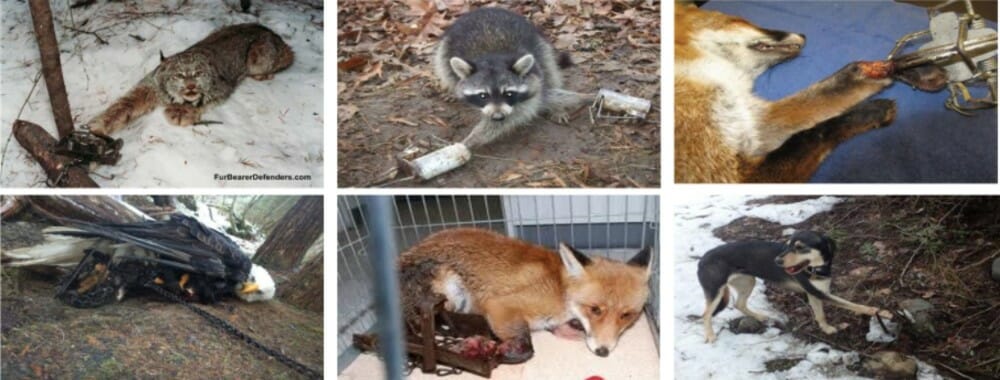
Regulatory agencies continue to use cruel steel traps, poisons, and shootings to kill wild animals, Ramdas said.
She also pointed to the 1930s and the start of “vermin” — a.k.a wildlife — killing contests, which led to the elimination of thousands of apex predators like bears, wolves, coyotes, and cougars.
The ‘contests’ — illegal in only seven states — still continue today and have factored into what Ramdas called “trophic downgrading,” or an imbalance in ecosystems that lose their apex predators.
“We do not understand the intrinsic value that wildlife give us,” she emphasized. “We treat them as replaceable.”
One serious and negative repercussion from trophic downgrading is an increase in predators’ prey base that then get labeled as “vermin” or “nuisance” species — think, for example, of areas overrun with populations of white-tailed deer.
Ramdas noted that official agencies employ a number of mind-bending strategies to make the abuse appear more palatable to the public. One such age-old strategy to pivot perception is the use of labeling and euphemisms.
Hunting becomes a “cost-effective public management tool.” Wild animals get recategorized as “invasive species,” “obnoxious animals,” “pests,” “trophies,” or “nuisances.”
WS used such language in its response to Lady Freethinker, when Keirn classified roughly half of wild animals the agency kills each year as “invasive species.”
Those animals included the brown tree snake in Guam, nutrias in marsh and coastal wetlands, and wild pigs that caused $1.5 billion of damage to natural and agricultural lands, Keirn said.
More compassionate — and effective — alternatives to lethal killings of wildlife already exist
While solutions to wildlife conflicts aren’t necessarily simple, Ramdas noted numerous already-established, effective, and more humane alternatives exist, such as using biological controls, relocation, fencing, and humane sterilizations.
Keirn, the WS spokesperson, said the agency has advocated for nonlethal methods since 1905 — including the use of contraceptives, vaccines, repellants, noise-making and other visual or auditory stimuli to scare off wildlife, fencing, and night penning.
“Wildlife Services frequently recommends nonlethal methods, and these methods are often implemented directly by those who have requested assistance,” she said.
Here’s a quick recap of the Q&A hosted with Ramdas by ALDF about some of today’s most pressing and concerning wildlife issues.
A Q&A with Researcher Sahana Ramdas
What’s going on with the listings for the country’s grey wolves?
Ramdas said that listing, de-listing, and re-listing species under the Endangered Species Act (ESA) makes them more vulnerable to extinction. She added that no other species in our country has been so persecuted and maligned by changes to its status as the grey wolf. While the animals formerly were protected by the ESA, they got downlisted in November 2020. Despite that de-listing, Ramdas said grey wolves haven’t recovered; they only dwell in an estimated 20 percent of their former range land, meaning they are still extant in the vast majority of lands where they used to roam.
Ramdas added that the grey wolves’ situation is another example of how regulatory agencies often align more with political priorities than their intended missions or animal welfare — noting that the Trump administration was well-known for promoting hunting on public lands while simultaneously rolling back protections for wildlife.
Are public lands labeled as “refuges” safe for wildlife?
Ramdas said there are two types of refuges: those with designations to protect and conserve wildlife (and so serve as refuges in the truest sense of the term), and those with “public lands” designations where officials stock “game” populations and permit licensed hunting during established seasons.
What can people do to help the wildlife?
Ramdas encourages people to contact their legislators and advocate against inhumane trapping and lethal management tools. She also says people should start talking to others about the inhumane management strategies, as well as the inherent worth of wildlife to help raise awareness.