South Korea’s final Bok Nal before the country’s dog meat ban takes full effect has now passed – something that would once have seemed almost impossible. Next year, for the first time, Bok Nal will take place in a South Korea where the dog meat trade has been banned.
That is what we fought for – and what you helped make possible by signing petitions, supporting investigations, and refusing to let the suffering of these dogs be ignored: a future where dogs will be spared the cages, markets, and slaughterhouses that caused so much suffering for so long.
With most registered dog meat farms already closed and once-busy dog meat markets falling quiet, this is a moment to recognize how far the movement has come, honor the dogs for whom change came too late, and carry that determination into the fights that remain.
This summer marked an important milestone for dogs in South Korea: the final Bok Nal before the country’s dog meat ban takes full effect.
Bok Nal refers to three traditionally designated days during the Korean summer, when dog meat consumption historically peaked, and restaurants serving bosintang (dog meat soup) were at their busiest. This year, the final Bok Nal – Mal Bok – fell on the 14th August, marking the end of an era for South Korea’s dog meat trade.
But next summer will be different.
In January 2024, South Korea’s National Assembly passed landmark legislation banning the breeding, slaughter, distribution and sale of dogs for human consumption. The vote was overwhelming: 208 lawmakers voted in favor, none voted against, and just two abstained. The legislation had support from all major political parties – an extraordinary consensus on an issue that had divided South Korea for decades.
The law provided a three-year transition period for farms, slaughter businesses, distributors, and restaurants to close or change their businesses, and so from February 7th next year, breeding, slaughtering, distributing, or selling dogs for human consumption will be prohibited nationwide.
That made this summer’s Bok Nal the last to take place while South Korea’s dog meat trade remains legal.
Historically, an estimated 70-80% of South Korea’s annual dog meat consumption took place during the summer Bok Nal period, making it one of the most important times of year for the trade.
This year, the contrast was striking: At Moran Market in Seongnam, once one of South Korea’s best-known centers of the dog meat trade, streets and specialist restaurants were reported to be nearly empty, while many former dog meat businesses had already switched to alternatives.
The empty tables and quiet markets told a powerful story: An industry that once depended on Bok Nal is now visibly fading away.
For Lady Freethinker, this milestone carries special meaning.
South Korea has long held particular significance in the fight against the dog meat trade because of the industry’s sheer scale and industrialization. Dogs were bred commercially on vast farms, some housing thousands of animals in endless rows of metal cages.
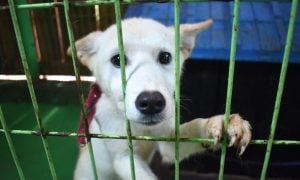
Some were abandoned pets, still wearing collars from their former lives; But many were born into those cages and spent their entire lives there – with no comfort, no freedom and no respite. For some, the only time they ever left a cage was when they were taken to slaughter.
For years, LFT worked alongside South Korean advocates to expose that cruelty and push for lasting change.
LFT investigations exposed the reality of massive commercial dog meat farms, documenting row after row of dogs confined in filthy, rusted cages. Witnessing their suffering first-hand was devastating. Seeing dogs spend their lives behind metal bars – their bodies marked by years of confinement, the fear in their eyes, the complete absence of any comfort or respite – was heartbreaking.
Seeing Moran Market in its heyday, with row after row of dogs waiting to be selected for slaughter, and watching the fear in their eyes when their turn came, was one of the most profoundly sad and disturbing experiences of all. For those dogs who had already endured the misery of life on a dog meat farm, to end up in a place that seemed to smell of fear and death was almost unbearable to witness.
Those are images that stay with you. They are why we fought for a future in which those farms would close, those cages would stand empty, and no more dogs would endure what so many before them had suffered.
We always knew change on this scale would not come easily, but our commitment never wavered. Too much was at stake, and too many dogs were still suffering, to stop fighting.
LFT’s investigations were part of that sustained pressure.
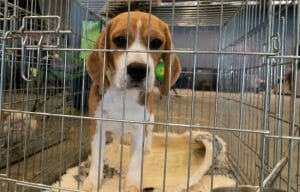
At the Nakwon Auction House in Namyangju, LFT investigators documented hundreds of dogs packed into metal cages and sold to buyers. Following the investigation and pressure from our partners at Save Korean Dogs and other advocates, officials shut down the auction.
In Icheon, another LFT investigation exposed dozens of dogs confined in cramped cages at an illegal auction. Tens of thousands of supporters signed LFT’s petition demanding action, helping build the pressure that ultimately led to the auction being shut down and demolished.
South Korean advocates spent years exposing the industry, rescuing dogs, changing public attitudes and calling on lawmakers to act. International groups amplified those efforts, while supporters like you signed petitions, donated, and refused to let the suffering be ignored.
Then, in 2024, the breakthrough finally came.
Since the law was passed, the dog meat farming industry has been disappearing remarkably quickly. South Korea originally registered 1,537 dog meat farms under the transition program. By May 2026, 1,265 of them – around 82% – had already closed, leaving just 272 operating ahead of the February 2027 deadline.
Even now, as we celebrate how far South Korea has come, we cannot forget the dogs for whom this change came too late. The dogs who spent their lives on farms. The dogs transported to auctions, markets, and slaughterhouses. The dogs who suffered and died before the law changed. They are part of this story, too.
South Korea’s historic victory also shows us something incredibly important: Change is possible, even when the problem seems overwhelming.
For years, the industry seemed deeply entrenched, with thousands of dogs trapped in farms, markets, and slaughterhouses across the country. But laws can change. Public attitudes can change. Industries can end. That’s why South Korea’s story matters far beyond its borders.
The fight to end the dog meat trade is not over.
Lady Freethinker launched PROJECT Sulawesi in Indonesia, working with local partners and government authorities in one of the country’s major dog meat trading and consumption hotspots.
The project combines efforts to stop the movement and sale of dogs for meat with new laws, rabies prevention, mass vaccination, public education, and stronger enforcement – tackling both the cruelty of the trade and the serious public health risks it creates.
South Korea reminds us that determined, sustained advocacy can change the future.
To everyone who signed a Lady Freethinker petition, shared our investigations, supported our work, or spoke up for these dogs: Thank you.
Your voice helped expose what was happening behind closed doors. It helped keep pressure on authorities in the position to effect change. And it helped support a much bigger movement – led by determined advocates in South Korea – that ultimately brought the country to this historic moment.
There is still work ahead wherever dogs continue to suffer in the meat trade. But South Korea has shown us that even the most entrenched cruelty can, and must, be challenged.