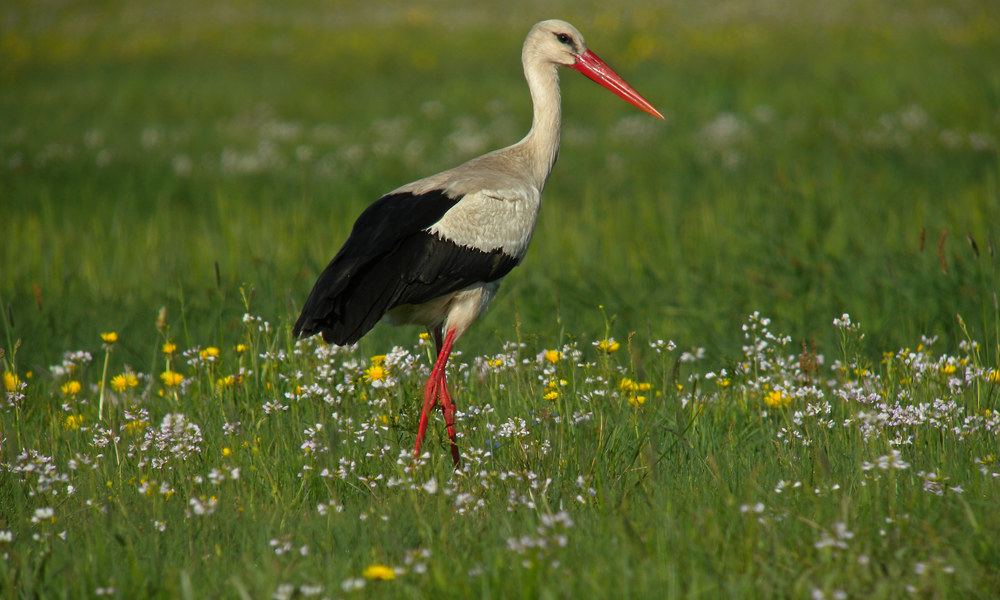
After more than 600 years without a resident breeding population, white storks are walking through the long grass of England’s Midlands once again. Three captive-bred juveniles have arrived at Willington Wetlands in Derbyshire, bringing with them the hope that these remarkable birds might one day nest and raise young in the region.
Their arrival does not mean storks are flying freely over the Midlands just yet. The young birds live in a purpose-built, predator-proof enclosure and will not be released. Even from within their protected meadow, however, they could help begin something extraordinary. Derbyshire Wildlife Trust hopes the trio will act as a “social magnet,” encouraging wild storks traveling through the Trent Valley to pause, gather, and perhaps make a home nearby.
White storks disappeared from Derbyshire and the wider Midlands around the 14th century as habitat loss and hunting took their toll. Yet wild storks have not forgotten the route entirely. Birds were seen over Willington in 2024 and nearby in 2025, although none stayed to breed. Now, for the first time in centuries, passing storks may look down and see other members of their species waiting below.
Sometimes a homecoming begins with something as simple as passing storks seeing others in the meadow below. White storks seek safety in numbers and often return to the place where they hatched when it is time to breed. Artificial nesting platforms tucked among the reserve’s trees offer another invitation to stay. If the enclosed birds eventually raise chicks, those young storks may become candidates for carefully managed release and could come to know the Trent Valley as home.
Willington Wetlands seems beautifully suited to this hopeful new chapter. The 113-acre reserve rests beside the River Trent on land once worked as gravel pits. Years of restoration have transformed it into a patchwork of wet grassland, open pools, and reedbeds where storks can forage and nest. Beavers reintroduced to Willington are also helping the wetland flourish, continually reshaping habitat for a host of other animals.
Every part of the storks’ enclosure has been planned with the future in mind, from breeding and chick development to the possibility of carefully managed releases. Volunteers will help restore the habitat, feed the storks, and check on their well-being each day with guidance from Celtic Rewilding, the Staffordshire conservation group that bred the juveniles.
When the crates opened, no one hurried the siblings. One stork stepped into the meadow and stretched their wings. Another moved slowly through the grass. Soon, all three were exploring the enclosure that will give them time to grow, settle, and simply be storks. It was a quiet beginning after an absence measured in centuries.
Farther south, white storks have already offered a glimpse of what such a return can become. Lady Freethinker celebrated five wild white stork chicks hatching at the Knepp Estate in West Sussex in 2020, marking Britain’s first recorded wild brood in centuries. The Willington project is a separate effort, but it carries the same wonderful possibility of helping these long-absent birds find their way home.
For now, the future begins quietly, with three young storks, a protected meadow, and people watching over them. If the project succeeds, a sight missing from the Midlands for 600 years could become part of ordinary life again. White storks may one day circle above the wetlands and build their nests beside the River Trent, bringing a bird of memory and folklore back into the living landscape.