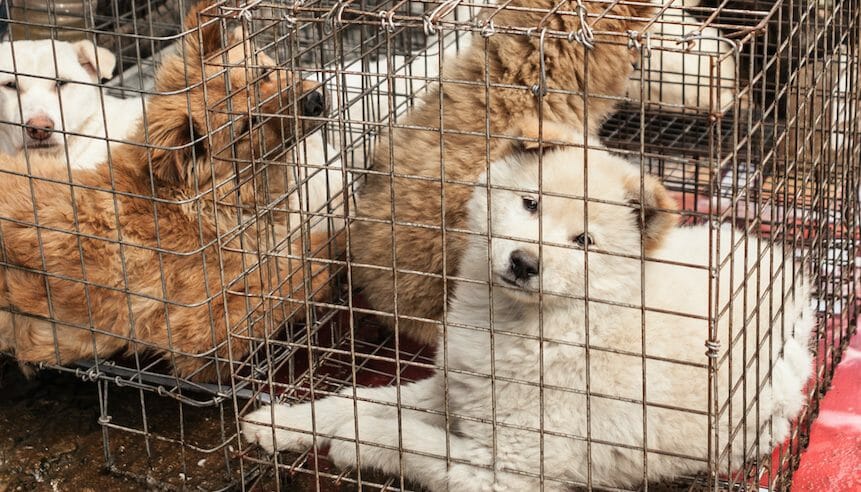
As the Yulin dog meat “festival” approaches, renewed calls to protect dogs and cats are exposing both the cruelty that remains and the progress already being made.
A horrifying alleged cruelty case in Chongqing has sparked protests and renewed demands for stronger protection for dogs and cats across China. It has also exposed a devastating gap in the law: companion animals can suffer extreme cruelty, yet there is still no comprehensive national legislation protecting them.
But the response tells another story. Residents gathered to demand action, outrage spread across social media, and calls for justice became impossible to ignore. Across China, more people are refusing to accept cruelty in silence. Their demands are growing louder, pressure for reform is building, and the call for national protection for dogs and cats is becoming increasingly difficult to ignore.
Alleged Cruelty Case Sparks Protests
Last week, a 39-year-old man in Chongqing was accused of posing as a caring adopter to obtain dogs before allegedly abusing and killing them. Videos and allegations circulated online, provoking widespread anger.
One injured puppy was reportedly found with multiple fractures, damaged teeth, and part of her tail missing.
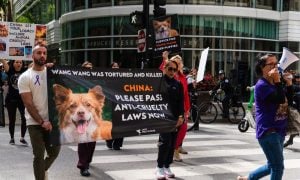
Outraged residents and animal advocates gathered outside the apartment complex where the suspect lived, calling for any surviving animals to be removed and protected. The demonstrations continued for several days as people demanded justice – not only for the dogs involved in this case, but for all companion animals left vulnerable to abuse.
The suspect was eventually detained, reportedly in connection with other alleged offences rather than animal cruelty itself. The case has become another painful reminder that China still lacks a national law specifically protecting companion animals from cruelty.
TAKE ACTION: Demand justice for dogs and cats allegedly tortured for online videos.
SIGN: Justice for Dogs and Cats Allegedly Tortured for Online Videos
Calls for Protection Are Growing Louder
The Chongqing protests are part of a growing movement across China, where people are speaking out with increasing urgency when dogs and cats are harmed. In 2023, residents protested after dogs were reportedly seized or killed during crackdowns on stray and unregistered animals. That same year, allegations that an online personality tortured and killed cats for videos triggered widespread condemnation. And in 2024, public outrage followed footage appearing to show a university student beating a kitten.
Each case has brought anger and grief. Together, they have also made one demand increasingly difficult to dismiss: dogs and cats deserve protection, cruelty must have consequences, and compassion must be reflected in national law.
As the Yulin Dog Meat “Festival” Approaches, the Push for Change Continues
The Chongqing case comes just days before the main trading period linked to the Yulin dog meat “festival,” held around the summer solstice on June 20–21. During this period, many thousands of dogs are traded and subjected to unimaginable suffering in crowded markets and slaughterhouses before being killed.
Yet Yulin is neither an official government celebration nor an ancient Chinese tradition. It was created by dog meat traders around 2009–2010 to increase sales – and it does not represent China or its people.
Most people in China do not eat dogs or cats. Some of the trade’s most determined opponents are Chinese rescuers, pet guardians, lawyers, activists, and concerned citizens campaigning within their own communities to bring it to an end. They rescue animals from trucks and slaughterhouses, expose abuses, challenge traders, press authorities to act, and demand stronger laws. Their work shows that opposition to the dog and cat meat trade is growing – and that meaningful change is already underway.
Signs of Hope: Progress Has Already Begun
Yulin remains a devastating symbol of the dog and cat meat trade. But suffering is not the whole story. Important reforms already achieved in China show that progress is possible.
In 2020, China’s Ministry of Agriculture and Rural Affairs excluded dogs from the national catalogue of livestock and recognized them as companion animals. Although this did not create a nationwide ban on dog meat, it marked a significant change in how dogs are officially regarded.
That same year, Shenzhen and Zhuhai banned the sale and consumption of dogs and cats. These landmark measures proved that stronger protections can be introduced in China – and that growing calls for compassion can become law.
The Yulin trade is also showing signs of decline. Campaigners report reduced activity compared with its peak, fewer visible displays of slaughter, and increasing scrutiny of how animals are sourced and transported. Authorities have previously closed markets and slaughterhouses, conducted road checks, and sought to distance the city from the event – further evidence that the trade is under growing pressure.
These measures have not ended the cruelty, and much more remains to be done. But every restriction, every rescued animal, and every public demand for protection pushes the trade further from acceptance.
Together, these advances show that change is not only possible – it has already begun.
TAKE ACTION: Call for an end to the Yulin dog meat event and China’s dog and cat meat trade.
SIGN: Stop the Horrific Yulin Dog Meat Festival and End China’s Dog and Cat Meat Trade
The Call for Protection Is Growing
Without a national law protecting companion animals from cruelty, dogs and cats across China remain dangerously vulnerable. But the Chongqing protests reflect a public increasingly unwilling to accept that injustice; the bans in Shenzhen and Zhuhai prove that demands for change can become legal protection; and the mounting pressure on Yulin shows that even an entrenched trade can be challenged.
China now has an opportunity to build on this progress by adopting strong national protections for companion animals and ending the dog and cat meat trade for good.