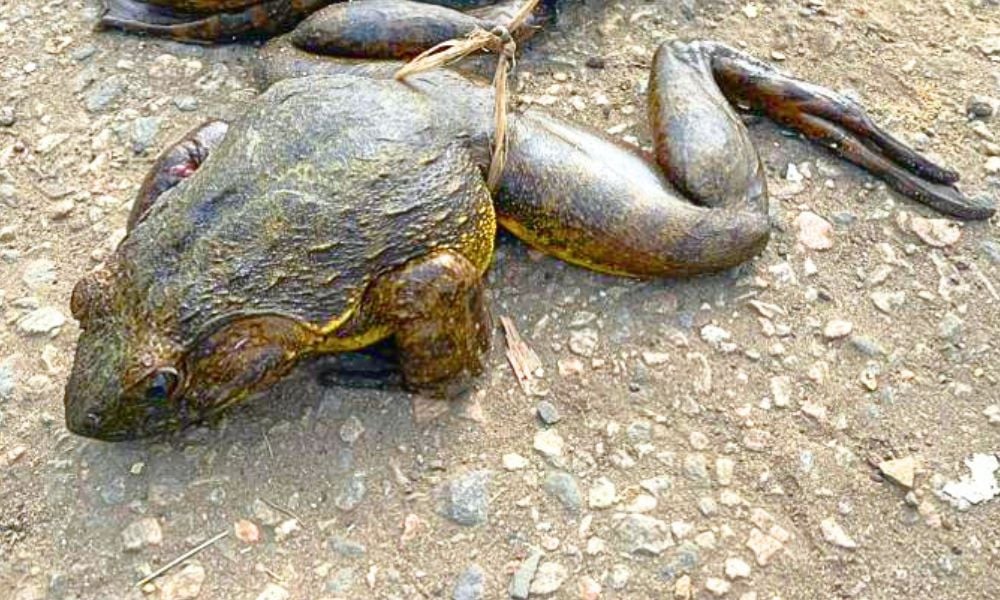
The Goliath frog — the largest frog species on Earth — is facing a growing crisis, with conservationists warning that without swift action, some populations could disappear within years.
Found exclusively in Cameroon and Equatorial Guinea, these remarkable amphibians can grow more than a foot long and weigh upwards of six pounds. However, advocates emphasize that the Goliath frog is not just a marvel of nature but also a flagship species that supports the health of its ecosystem and even eco-tourism. Goliath frogs feed on insects that damage crops, making them important to the food chain. In addition, their tadpoles eat algae, which aids in cleaning water sources in the region.
Unfortunately, a combination of deforestation, hunting, pollution, and other human activities is driving the animal to the brink of extinction.
“The Goliath frog could disappear within our lifetime without immediate and coordinated conservation action,” said Che Gilbert Ayunwi, international representative for International Organization for Animal Protection (OIPA) Cameroon. “Its loss would be irreversible.”
Thankfully, efforts are underway to reverse the decline. OIPA Cameroon is working on the ground to protect remaining populations through research, education, community engagement, and collaboration with authorities to safeguard habitats and curb hunting.
In addition, researchers are mapping breeding sites and tracking population changes to determine where help is most needed, while conservationists are partnering with local authorities to strengthen wildlife protections and protect key habitats.
Lady Freethinker is deeply grateful to the dedicated conservationists fighting to save the Goliath frog. With continued support, there is hope that this remarkable species can recover before it’s too late.