
A passerby’s video last December captured a Vacaville police officer punching a K9 in the face while the dog lay flat on his back, vulnerable.
The video, which went viral on Facebook, sparked public outrage, a demand for accountability, and three commissioned investigations that concluded in April.
The handler will no longer work with canines but also will remain unnamed, due to alleged threats to his safety and cited protections afforded by the Peace Officer Bill of Rights. Meanwhile, K9 “Gus” was returned to Sworn K9 Services, the agency that sold him to the city for $9,000 of taxpayer-supported money from the city’s General Fund.
While the shocking incident has kept public attention on a particular handler and a particular dog, inconsistencies in the city’s commissioned reports point to larger questions about the overall welfare of the department’s dogs, the training methods used by the city’s long-time contracted K9 trainer, and the level of program supervision by department higher ups.
LFT dove into the released reports, reviewed close to 200 pages of disclosed public records documents, and spoke with multiple well-renowned K9 and police operations experts to get answers. Our analysis points to a department where documentation of critical training and supervisor oversight is lacking and canines are routinely subjected to “aversive” training methods — meaning ones in which physical force is used to obtain compliance.
Steve Brewer, the trainer with whom Vacaville has contracted since 2007, did not respond to multiple requests for comment.
What happened to Gus?
Gus, a 14-month-old Czechoslovakian Shepherd, traveled from Europe to Vacaville as a “green” — or untrained — dual purpose narcotics and patrol dog after the Vacaville Police Department purchased him in October via Vendor Sworn K9 Services.
In late December, he completed a routine narcotics training exercise but then refused to return the toy his handler had given him as a reward. The passerby’s video picks up with the handler looming over the dog — in what the city has since called an “alpha roll” technique — before he punches Gus in the face.
The department removed Gus from his handler and had him evaluated on Dec. 30 by a VCA Sacramento Veterinary Referral Center vet, who reported Gus was “bright, alert, responsive” and “doing fine.”
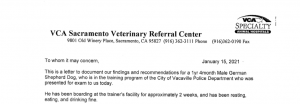
From VCA’s report
The department then sent him to Law Dogs and Steve Brewer, the city’s contracted trainer, who kenneled him for approximately two weeks.
On Jan. 15, the same vet who had evaluated Gus after the incident reported he was “in good health, with no pain nor behavioral problems.” But an inspection on Jan. 18 by Anchor Therapy Clinic’s Kevin Cameron — hired to evaluate Gus’ welfare and future workability as a police dog — reported the dog was “insecure,” “aloof,” “expecting to be corrected at all times” and “in a constant state of pain avoidance.”
Cameron also wrote that Gus was malnourished, with five to seven ribs “easily observable on either side of the canine,” and that “collars, shock collars, prong collars, and other traditional tools elicit a fear response from the canine.”
“There are significant concerns about the canine’s health and welfare,” Cameron wrote. “The canine shows numerous signs of neglect, cognitively and physically, that has occurred, and only can occur, over a significant period.”
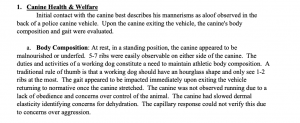
From Kevin Cameron’s report
Alarmed, the city sought a second opinion via independent investigator Bill Lewis II — a 27-year police veteran, certifying K9 team evaluator for California POST and California Narcotic Canine Association, and an expert K9 witness through Thomson Reuters and the Round Table Group.
Although Lewis did not ever observe Gus himself, he questioned Cameron’s credentials and findings and told the city council during an update that started at 11:30 p.m., “It is my opinion the policies, practices, and training of the K9 program meet standards. You have a good K9 unit.”
During the meeting, Vacaville leadership also discredited Cameron’s credentials, saying the 14-year combat veteran — who served as Afghanistan Country Manager for the Department of Defense (DOD)’s canine program, is a DOD certified trainer and handler, and is a recognized subject matter expert by the California State Senate for working dogs, service dogs application, use, and training— was not as qualified to conduct the evaluation as they had thought.
Cameron chafed at those comments, and the critique of his report, when he learned about them days later.
“I did meet with the current interim Chief of Police earlier this week regarding the comments about my qualification, and he was unaware of my background or credentials,” Cameron told Lady Freethinker via email on May 6.
Several council members also took issue with the city’s dismissal of Cameron’s expertise, the city’s late night update, and “only one side” of the story being presented during the council update. Councilmember Jason Roberts told Lady Freethinker he is trying to reintroduce discussion about Gus’ situation via a town hall meeting or during a future council meeting.
“I was disappointed in the information session as VCA and Anchor Therapy were not included,” he said. “I am a firm believer that all assessments and information on this topic should be presented and that the individuals be allowed to explain how those conclusions were developed. Not being transparent does not build confidence between the public and the police department.”
While the city’s preferred veterinary report gave Gus a clean bill of health and approval to return to duty, the city chose to return him because the department had no other trained handler able to take him at the time, said Interim City Spokesperson Kris Concepcion.
“While most dogs that join the police department stay with us, it is not uncommon for an agency to return a dog to a vendor,” Concepcion said. “We understand that Gus is doing quite well now.”
That statement was not verified by Lady Freethinker, as Sworn K9 Services did not return multiple calls for comment.

An invoice for Gus (Public records request, city of Vacaville)
What’s happening to Vacaville’s other K9s?
Police dog training in the ‘80s, used by so-called “old school” trainers, and still preferred by many departments today relies on “aversive” techniques — ones that use force to train dogs and that obtain obedience through the dog’s attempt to avoid pain.
Aversive techniques include pushing down on a dog to teach the command “sit,” or suspending a dog by the collar from a leash hung over a fence for a prolonged period to teach him “no” — sometimes called “airplaning” a dog.
Gregg Tawney — a police veteran with more than 25 years experience training dogs and who currently provides positive reinforcement-focused K9 training through his business D-TAC K9 to 21 law enforcement agencies — started his training with an aversive-focused trainer.
When asked about aversive techniques, he cited an example from “old school” trainer William Koehler’s book, a standard in the 1970s and still used by many trainers today, in which a dog dug a hole.
“You would come home, ignore the dog, fill the hole with water, submerge the dog’s head until he thinks he is going to die,” he said. “Then you do that seven times. And it’s 75 percent effective.”
But is the trauma to the dog worth it? Tawney, who never used the technique, never taught the technique, and who became a K9 handler because he loves dogs, doesn’t think so.
“You’ve fixed the problem of digging the hole, but you’ve completely destroyed the relationship with your dog,” he said. “These trainers may get results, but how they get those results is sometimes at the sacrifice of the dog. We owe it to the dogs to train smarter and use more humane methods.”

Rango, a retired police K9 who now is living with K9 Trainer Gregg Tawney and his family (Courtesy Gregg Tawney)
Cameron concluded in his report — based on discussions with a Vacaville K9 supervisor, a K9 handler, and Vacaville’s K9 trainer Steve Brewer — Vacaville’s dog teams “are only trained using aversive methods” and that Gus had been “significantly and negatively impacted by department working dog training methodologies.”
Concepcion, the city’s spokesperson refuted those statements, telling LFT that Vacaville’s K9 program “has never had a focus on ‘aversive’ training.” Yet Brewer, Vacaville’s trainer since 2007, is known in both U.S. and international K9 networks as a staunch member of the “old school” guard — one who turns out well-trained dogs but relies on aversive methods to do so.
Bob Eden — a 28-year veteran, with more than 40 years in working dog training, who is founder of the internationally acclaimed K9 Academy for Law Enforcement, and is currently located in Canada– said he knew Brewer and classified him as an “old school” trainer.
“I do not agree with some of his training methods,” Eden said. “But he would likely not agree with some of mine.”
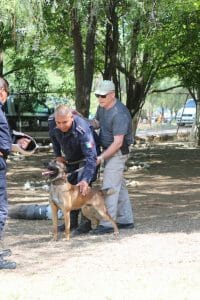
Bob Eden training at an International K9 Conference hosted by the Mexican police in Guanajuato, Mexico. (Courtesy Bob Eden)
Tawney, who also said he knew Brewer and considered him to be an “old school” trainer, reviewed the footage involving Gus.
“I feel bad for the dog and the handler,” he said. “I believe that was something the handler was trained to do.”
The city’s contract with Brewer doesn’t delineate the specific type of training methods he uses. The document notes only that Brewer is responsible for canine selection, maintenance training for a minimum four hours per week, and “basic training” — to cover patrol, obedience, obstacle course, field and building searches, “aggression control,” narcotics, and tracking — in a scope of services not to exceed $50,000 per year.
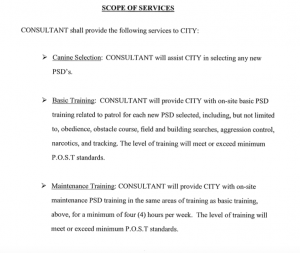
From Law Dogs’ contract with the City of Vacaville (public records)
Kyle Shoberg — owner of Shoberg Tactical Services and a 14-year law enforcement veteran (with seven years as a K9 handler) — began his K9 training under Brewer. He said he was taught to use the alpha roll technique as well as heavy use of an electronic collar to train dogs.
“The alpha roll was a big topic. We were trained to do that,” he said. “It was a little heavy handed with the dog. It was old school techniques.”
At one point, Shoberg said that hanging his first K9 Dax from a tree as a discipline measure came up as an option — one that thankfully was immediately shot down by a new K9 supervisor who had joined the department, who had trained with Tawney, and brought a positive reinforcement-based philosophy to the unit. Shoberg added that he had never seen any dogs strung from trees while he was training with Brewer.
But regarding the Vacaville incident, Shoberg said people should widen their focus.
“They shouldn’t be looking at the handler, they should be looking at what caused him to act this way,” he said. “I feel really bad for that officer at Vacaville. He was a brand new handler. He was likely doing what he was told, what he was trained to do.”
The cost of force-based, aversive K9 training
Tawney pointed to the costs that come when members of the public witness aversive methods.
“Vacaville got destroyed in their PR over that,” he said. “The cost of that one incident was tremendous. No one wants to think of their handlers punching a dog. ”
But there are other reasons why reliance on aversive techniques can be dangerous — not only for the dogs, but also for their handlers. Eden said using force-based techniques with dogs selected for their high aggression and drive is asking for conflict.
“I’ve seen dogs hospitalize their handlers,” he said. “The more the stress and cortisol levels build up in the dog, the less clearly that dog is going to be able to think. And that works against us in law enforcement.”
Concepcion said the Vacaville Police Department does not track K9 bites to handlers during training exercises but added that no handlers required medical attention after being bit by their dogs in 2020.
“Even though the Vacaville PD does not track this data, we would like to reiterate that neither our training nor our policy focus on aversive methods,” Concepcion said.
Concepcion added that the department’s policy and K9 Field Training Manual speak to the training required to meet California Peace Officer Standards and Training (POST) requirements but do not address specific correction techniques to be used by handlers.
“Our handlers are trained to utilize a variety of correction techniques, which include some aversive methods,” he said. ” However, our training actually focuses on positive reinforcement.”
Where are the breakdowns happening in K9 care, training and oversight?
A review of national policies, legislation, and K9-related lawsuits by K9 Expert Scott Sargent pointed to three main issues that get police K9 units in trouble: poorly written policies, training, and a lack of supervisory oversight.
Those three liabilities match up with several identified areas of improvement that Lewis, the independent investigator, overviewed in his findings to the city council when he said Vacaville’s K9 unit “could be better” in terms of documentation, training standards, and performance reviews — followed by the overview of his 39 collective recommendations.
K9 Handler Selection and Training
To be selected as a Vacaville K9 handler, officers must meet five basic criteria. They have to be off probation and willing to serve as a K9 officer for at least three years. They also have to be living in a fenced, single-family residence with a garage that can accommodate a K9 vehicle, within 30 minutes from Vacaville city limits.
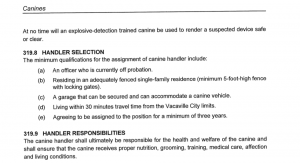
From Vacaville’s K9 policy
The department’s policy doesn’t require previous experience with dogs, although it does note that handlers are responsible for the health and welfare of the police dogs.
Lewis noted that “it does not appear the training to properly care for the police dog is being required or made available.” He also noted the department had:
- No documentation of a ‘basic handler’s course’ for K9 handlers, covering critical animal welfare topics such as first aid, nutrition requirements, grooming, bathing, exercise, socialization, or at-home health inspections
- No evaluation period for handlers upon their initial assignment
- No off-duty K9 care chart
- No test or checklist to ensure a handler understands policies and procedures related to K9 assignments
- No annual proficiency or performance-based testing other than an annual POST-certification
- An estimated 90 percent of training focused on the dog, with 10 percent of training focused on the handler
Lewis noted that while the city had contracted to pay Brewer $200 per K9 team per month, city invoices were showing Brewer pocketing $250 per team per month. He also noted a clause that the amount would be paid “irregardless of the police service dog or handler’s presence” at the training.
Lewis also reported that he had observed “inconsistencies” with training outcomes in two exercises he observed during his March evaluation, in which K9 teams did not complete the exercise appropriately but recorded on their training logs that they had.
K9 Supervisory Oversight of Training
As for supervisor oversight of the training program, Lewis noted the department hosted “Fifth Wednesday” discussions and debriefs about K9 matters — or roughly four times a year.
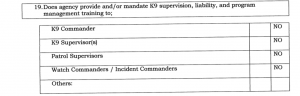
From a city commissioned investigative report by Bill Lewis II (City of Vacaville)
Other than that, based on his review of the department’s policies and documentation, Lewis noted that K9 supervisors have no access to inclusive training files for each K9 handler, are not required to attend maintenance training, and have no provisions in their contract with their trainer for documented training or periodic evaluations of the K9 teams.
“A review of the training documentation is not being conducted nor evaluated to determine levels of performance or verify consistency of information being reported,” he said. “There is no evidence of any documentation or performance evaluations to verify if training is meeting or exceeding POST standards.”
Lewis added that Brewer’s contract required a minimum four hours of training each week that meet or exceed POST standards.
“I was told that documentation to verify these contractual conditions does not exist,” he wrote.
Concepcion, the city’s interim spokesperson, said the department’s current K9 supervisor, Sgt. Frank Piro, has “extensive knowledge of the program and the training.”
“He personally attended Steve Brewer’s basic training as a K-9 handler and underwent maintenance training with him for years,” Concepcion told LFT. “Since taking over the K9 unit in 2018, Sergeant Piro has routinely attended training and has firsthand knowledge of the instruction Steve Brewer is providing to our current K9 handlers.”
There Is A Better Way
Shoberg, the K9 handler who trained under both Brewer and Tawney at different points in his career, said their styles are “polar opposites” — and he prefers the more humane and positive methods.
“I had noticed the adverse effects of hard corrections on my first dog,” he said. “When I started using positive reinforcement, I really enjoyed it, and I could tell the dog wanted to work for me. The bond was there, and I didn’t have to use any harsh methods to change his behavior.”
None of the trainers and K9 experts who spoke with Lady Freethinker endorsed a “positive reinforcement only” method for training K9s, whom they noted must be under officer control for public safety reasons.
But they did advocate for humane and balanced training.
“For several reasons, it is not appropriate to strike a dog in the face,” said Sargent, who reviewed the Vacaville reports and the city council meeting. “It can cause serious injury and it is humiliating to the dog. This can result in a loss of trust and possibly result in even more handler aggression. There are several ways for a handler to assert dominance over a difficult dog that don’t include kicking or punching.”
Eden also said there are times when dogs have to be corrected but added, “That doesn’t mean it has to be heavy handed.”
Eden’s methods at international conferences, which attract an average 150 police departments each year, focus on positive motivation. He lets the dog make a choice. If the dog chooses to listen, he gives the dog a reward. If the dog does not listen, he takes away the reward.
“When you train the dog like that, the dog self-eliminates unwanted behavior,” Eden said. “There are some extremely talented individuals in law enforcement who have gotten it. The bond is important. The better the dog and handler get to know each other, the better the dog understands expectations and the better the handler knows the dog’s behavior so he can make better decisions on the streets. You want a dog to respond as reliably as possible because your life depends on it.”
The shorter training programs becoming more popular with resource-strapped departments doesn’t allow for that bond, he added.
“You can’t train a dog in four weeks,” he said. “It’s a liability waiting to happen. The dogs could be solid, the handler could be solid, but they just hadn’t had the time. When you train a dog for 14 weeks, you know that dog. You know how to fix an issue if it comes up with that dog.”
Tawney also chose a positive reinforcement focus, despite the time investment, because of the resulting bond between canine and handler, which he added is crucial for operation effectiveness.
“Positive reinforcement takes longer, but long-term, you have a much better package,” he said. “The dog wants to do what I want him to do, and I didn’t have to beat him up to do it.”
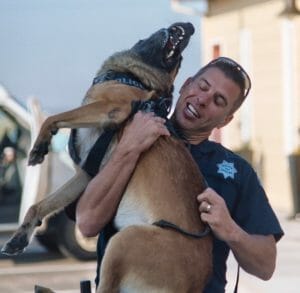
K9 Trainer Gregg Tawney with his Police Partner K9 Rombo (Courtesy of Gregg Tawney)
Tawney frequently uses clickers to signal to a dog that he has done something right, which buys him extra time to get the toy the dog wants while allowing the dog to understand why he’s getting the reward. While some members of the “old school” trainers have scoffed at his use of clickers, he stands confident in the benefits for his handlers and their dogs.
“At the end of the day, you have to decide what kind of trainer you want to be,” he said. “You signed up to be an officer. They [the K9s] were drafted. So it’s up to us to use the most humane methods possible.”
The dogs deserve that much for the life-saving work they do, he added.
“There is no doubt that they save lives,” he said. “We’ve had numerous situations that could have required deadly force but didn’t because of the canines. Mentally, they also save officers lives. We don’t really talk about that aspect, but you can endure more because you have the dog as a companion. After a hard day, that dog is there for you, and he’s happy to see you.”
What needs to happen now
Despite their conflicting accounts regarding Gus’ abuse, both Lewis and Cameron said there’s hope for Vacaville’s K9 unit.
“In my dealings with the Vacaville Police department, I believe they are diligently working to fix a deficiency in their program that they were unaware of,” Cameron told LFT. “The struggles that the Vacaville PD is having are common in the K9 community. K9 is a specialty unit with a tight knit community, and expertise is challenging to find. Department managers only know what their contracted trainers tell them, and that is often where problems arise.”
Sargent, based on his reviews of the reports and his viewing of the April 27 council meeting, also weighed in.
“In my opinion, they were fairly responsive and seem to have been transparent and certainly far more thorough than I have seen with most agencies,” Sargent told LFT. “Some [departments] are still ‘no comment.'”
Vacaville City Council Vice Mayor Nolan Sullivan told Lady Freethinker the city is gearing up to conduct an outside, third-party firm to conduct a full audit of all law enforcement activities — including the K9 unit — upon the hiring of the city’s next police chief.
“This is not happening as a routine matter of business,” Sullivan said. “This is happening because we recognize there is room for improvement, implementing additional best practices and an unbiased outside look at what we are doing good or bad. I am confident in this approach and that as a city we will be seriously and systematically addressing issues that have presented themselves over the last year.”
If you haven’t already, please sign our petition asking the Vacaville City Council to follow-through with comprehensive, independent overview and oversight of the city’s contract with its K9 trainer, to require ongoing and humane training (including education on dog welfare) to K9 handlers, to insist on documented training supervision to ensure K9 teams are trained to the highest level possible using humane methods, and to ensure that the police department provides regular updates to the council and members of the public about the department’s training methods to increase transparency and rebuild public trust.
SIGN: Justice For Vacaville K9 Punched in the Face and All Abused Police Dogs in the City